
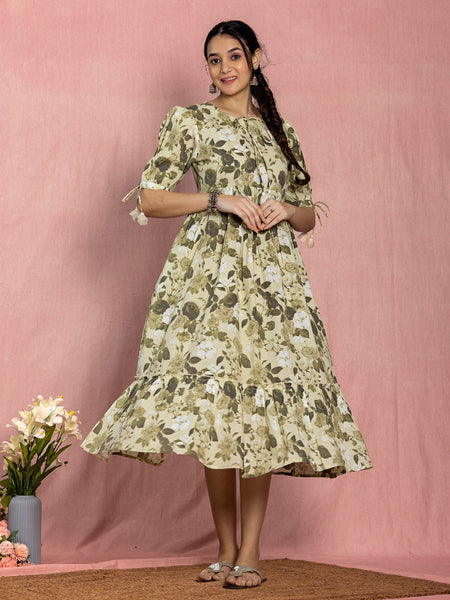
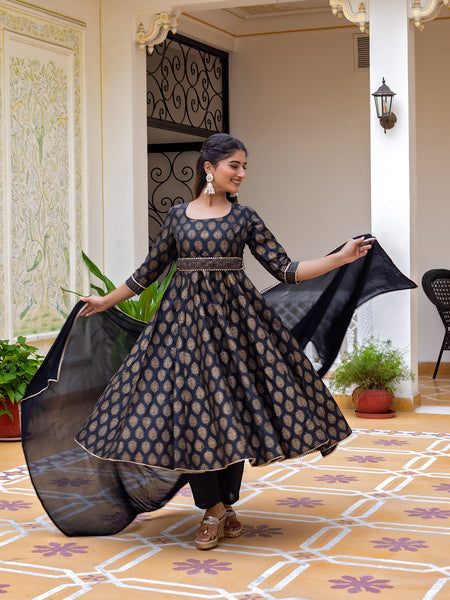
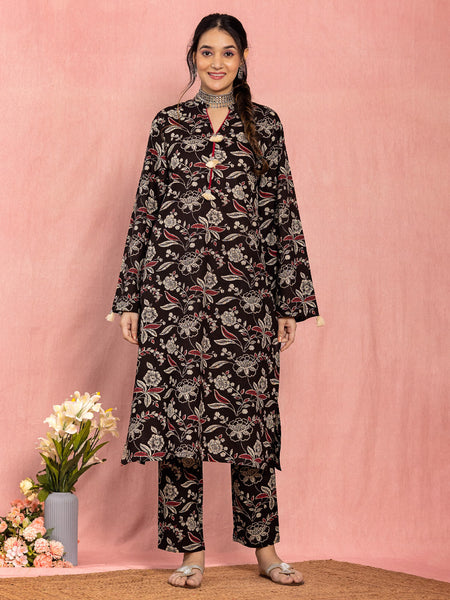
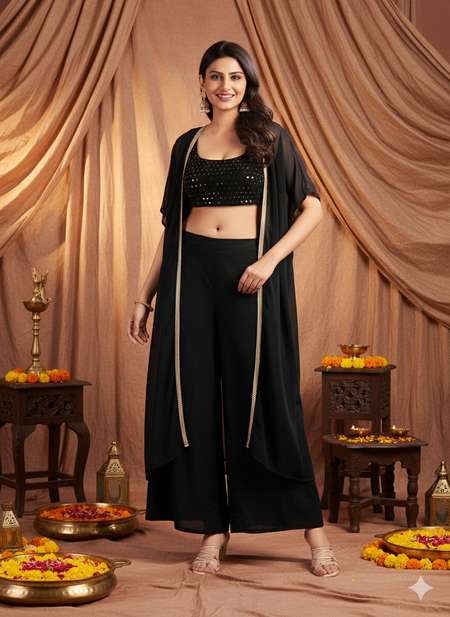
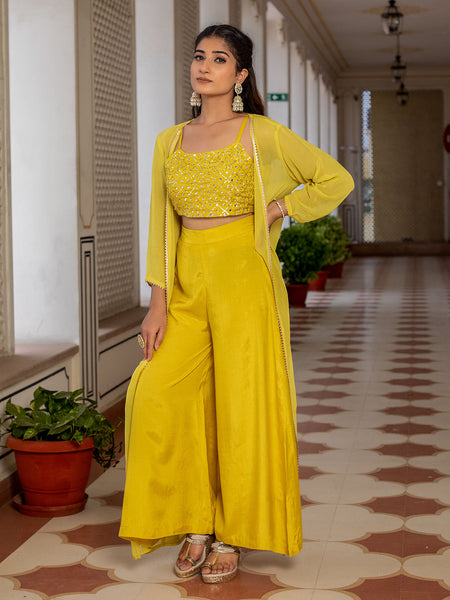
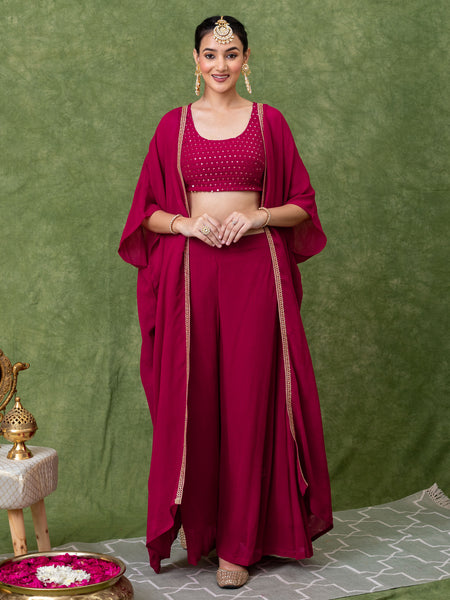

The three silhouettes get used interchangeably online — but they're built differently, originated differently, and suit different women. A clear-eyed comparison.
Three Silhouettes, Often Confused
Search "Farshi Salwar" online and you'll find images of Shararas mixed in. Search "Anarkali" and you'll see Farshis tagged the same way. The three silhouettes — all rooted in Mughal-era Indian dressing — have become conflated to the point where most women buying online aren't sure what they're actually getting.
They're not the same. They have different histories, different cuts, and different effects on how a woman looks and moves. Here's how to tell them apart, and how to choose what works for you.
The Farshi Salwar

Origin: 17th-century Mughal courts. The name comes from the Persian word farsh, meaning floor.
Cut: A floor-length salwar with deep, sweeping volume — gathered at the waist, generous through the leg, hem trails the ground. Worn with a separate kurta on top.
What it does to the silhouette: Adds drama through the bottom half. The volume below acts as the visual anchor, which means the top can stay minimal — fitted kurtas, short jackets, even a simple shirt.
Best for: Women who want presence without effort. Tall and short heights both work — the hem trail forgives both. Comfortable for long events because the leg has room to move.
The Sharara
Origin: Lucknowi nawabi culture, 18th–19th century. Worn by women of the Awadhi nobility.
Cut: Wide-legged pants flared dramatically from the knee down. Two-piece construction — narrow at the thigh, then opening into bell-shaped volume below. Worn with a kurta on top, traditionally hip-length or longer.
What it does to the silhouette: Creates a defined hourglass. The narrow thigh-line followed by sudden flare draws the eye. More structured than a Farshi — the volume only starts halfway down.
Best for: Women who like a more defined waist-to-leg transition. Best paired with longer kurtas to balance the bell flare. Slightly less forgiving for casual wear because the construction is more deliberate.
The Anarkali
Origin: Mughal-era performance dress. Named after the legendary courtesan Anarkali in Akbar's court.
Cut: A long, flared kurta or frock with a fitted bodice — the fullness lives in the kurta itself, not in the bottom. Worn with churidar or fitted leggings underneath. Can be floor-length or calf-length.
What it does to the silhouette: Creates one continuous flared shape from chest to floor. The fitted bodice highlights the bust and waist; the flare hides everything below.
Best for: Women who want to dress up without adding bulk to the lower half. Easier for women who prefer fitted leggings to wide bottoms. The most forgiving of the three for shorter heights — the vertical line elongates.
Side-by-Side: Where the Volume Lives
The simplest way to remember the difference is to ask where the volume sits:
| Dimension | Farshi Salwar | Sharara | Anarkali |
|---|---|---|---|
| Origin | 17th-century Mughal courts | Lucknowi nawabi culture, 18th–19th century | Mughal-era performance dress |
| Where the volume sits | Bottom — gathered at waist, full through leg, hem trails | Bottom — from the knee down, bell-shaped flare | Top — flared kurta with fitted bodice |
| Best top to pair | Short or hip-length kurta, fitted shirt, short jacket | Longer kurta to balance the bell | Built-in (the silhouette is the kurta) |
| Bottom worn underneath | None — the salwar is the bottom | None — the sharara is the bottom | Churidar or fitted leggings |
| Best suited for | Drama with minimum effort; works across heights | Defined wedding-guest looks; more formal register | Elongating silhouette; flattering across body types |
Once you see it that way, they stop blurring together.
Which One Suits You?
If you want maximum drama with minimum effort
Go Farshi. The volume does the work, the styling stays simple, and the silhouette photographs beautifully without needing accessories or embroidery.
If you want a defined, classical wedding-guest look
Go Sharara. The structured flare reads as more formal and traditional. Best for events where the dress code is clearly festive.
If you want something fitted-but-flowy that elongates
Go Anarkali. The vertical line is universally flattering, the silhouette is one of the most photographed in Indian dressing for a reason, and it works across heights and body types.
If you want the most everyday-friendly
The Farshi wins here, especially in cotton. The Sharara and Anarkali both lean occasion-formal. A simple cotton Farshi can carry through brunch, errands, and an evening dinner without changing.
What They Have in Common
All three came from the same place — Mughal-era India, where women of court dressed in volumes that signalled status, leisure, and wealth. They were never meant to be efficient. They were meant to be worn slowly, in spaces designed for slow movement.
Three centuries later, a generation of Indian women is choosing them again — not because they're efficient, but because efficiency turned out to be the wrong thing to ask of clothing in the first place.
Frequently Asked Questions
Is Farshi the same as Sharara?
No. Both have volume in the bottom half, but a Farshi is gathered at the waist with continuous fullness through the entire leg — the hem trails the floor. A Sharara is narrow at the thigh and only flares from the knee down, creating a bell shape.
Which is more comfortable: Farshi or Anarkali?
The Farshi. The leg has full room to move, the waist is gathered (not cinched), and the volume is in the bottom — meaning the top can stay relaxed. An Anarkali is fitted through the bodice, which can feel restrictive across long events.
Can a Farshi be worn like a Sharara?
Not exactly — the construction is different. But you can get a similar visual register by choosing a fitted top with a Farshi (the way a Sharara is traditionally styled) and adding a longer kurta over it for events where the Sharara's formality is the goal.
Which silhouette is best for shorter heights?
The Anarkali, traditionally — the vertical line from the fitted bodice down to the hem elongates the frame. But a Farshi works too, provided the hem ends just at the floor rather than significantly past it, and the kurta on top is fitted.
Explore Kasya's heritage-rooted Farshi co-ord sets — cut in pure cotton, made for daily life. Shop the Farshi collection →

